
UGC NET mein chahe aapka subject Commerce ho ya koi aur, Paper 1 sabke liye same hota hai. Iska naam hai "General Paper on Teaching and Research Aptitude". Achhi baat yeh hai ki iska syllabus fixed hai aur sawal kaafi had tak PYQ pattern par aate hain — isliye sahi planning se yeh paper aapke total score ko bahut upar le ja sakta hai.
Is guide mein aapko milega:
- Paper 1 ka exam pattern
- 10 units ka official syllabus, unit-wise topics ke saath
- Har unit ko kaise padhna hai
- Syllabus se judi aam galtiyan
Paper 1: exam pattern ek nazar mein
- 50 sawal, har sawal 2 marks ka — kul 100 marks
- Paper 1 aur Paper 2 dono milakar 3 ghante (beech mein break nahi)
- Negative marking nahi — koi sawal khaali mat chhodiye
- Aam taur par har unit se lagbhag 5 sawal aate hain (kabhi kisi unit se thode kam-zyada)
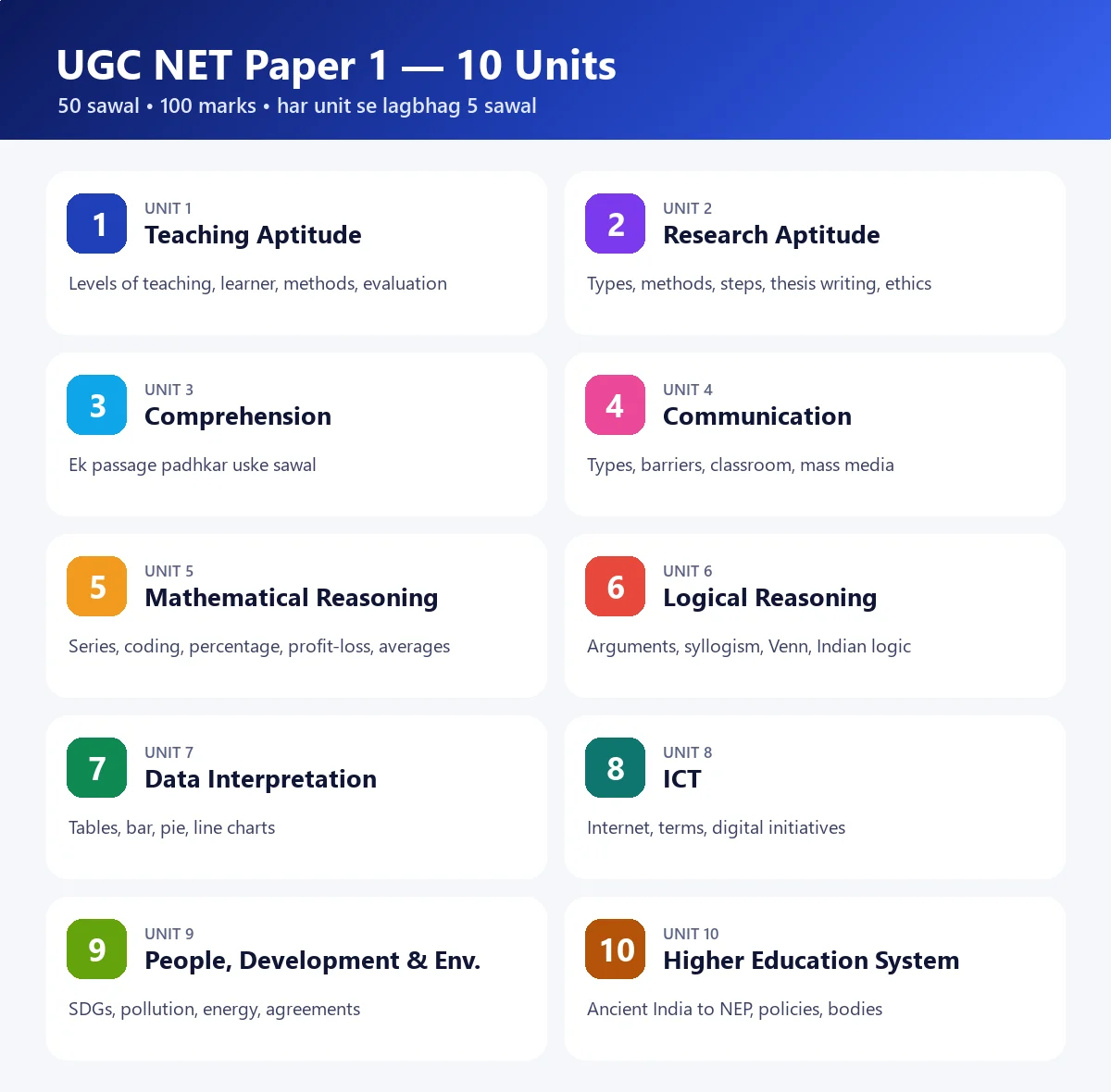
Unit 1: Teaching Aptitude
- Teaching: concept, objectives, levels of teaching (memory, understanding aur reflective), characteristics aur basic requirements
- Learner ki characteristics: adolescent aur adult learners (academic, social, emotional, cognitive), individual differences
- Teaching ko affect karne wale factors: teacher, learner, support material, instructional facilities, learning environment aur institution
- Higher education mein teaching methods: teacher-centred vs learner-centred, offline vs online (SWAYAM, SWAYAMPRABHA, MOOCs aadi)
- Teaching support system: traditional, modern aur ICT based
- Evaluation systems: elements aur types, Choice Based Credit System (CBCS) mein evaluation, computer based testing, evaluation mein innovations
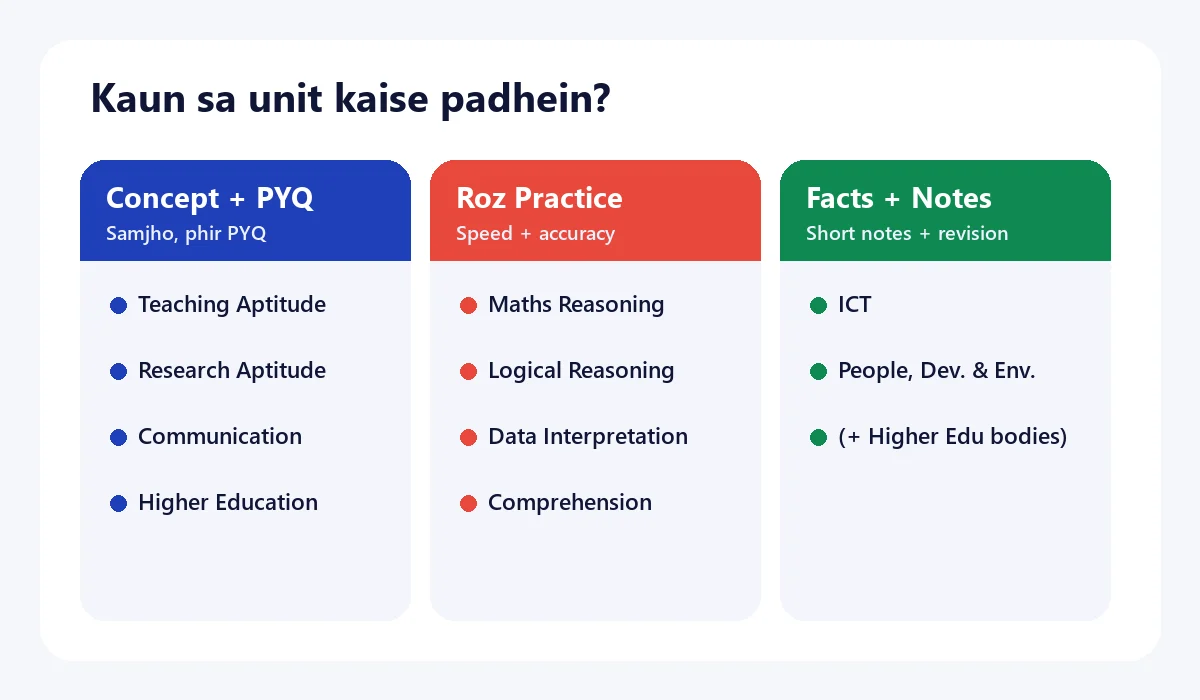
Kaise padhein: concepts samjhiye aur phir PYQ — is unit ke sawal aksar "best option chuno" type ke hote hain, jisme samajh kaam aati hai, ratta nahi.
Unit 2: Research Aptitude
- Research: meaning, types aur characteristics; positivism aur post-positivistic approach
- Methods of research: experimental, descriptive, historical, qualitative aur quantitative
- Steps of research
- Thesis aur article writing: format aur referencing styles
- Research mein ICT ka use
- Research ethics
Research Aptitude ke basic terms Talvir Sir ke is lecture mein dekhiye:
Unit 3: Comprehension
Ek passage diya jaata hai aur usi se sawal pooche jaate hain. Iske liye koi alag syllabus nahi hai — roz ek English passage padhne ki aadat aur PYQ passages ki practice hi taiyari hai.
Unit 4: Communication
- Communication: meaning, types aur characteristics
- Effective communication: verbal aur non-verbal, inter-cultural aur group communication, classroom communication
- Barriers to effective communication
- Mass-media aur society
Unit 5: Mathematical Reasoning and Aptitude
- Types of reasoning
- Number series, letter series, codes aur relationships
- Mathematical aptitude: fraction, time & distance, ratio, proportion aur percentage, profit & loss, interest aur discounting, averages aadi
Maths aur Reasoning ko 'mushkil' maan kar skip mat kijiye. Ye sabse scoring units hain — roz sirf 20–30 sawal ki practice se yahan poore marks aa sakte hain.
Unit 6: Logical Reasoning
- Arguments ka structure: argument forms, categorical propositions ka structure, mood aur figure, formal aur informal fallacies, uses of language, connotation aur denotation of terms, classical square of opposition
- Deductive aur inductive reasoning ko evaluate aur alag karna
- Analogies
- Venn diagram: arguments ki validity check karne ke liye simple aur multiple use
- Indian Logic: means of knowledge
- Pramanas: Pratyaksha (perception), Anumana (inference), Upamana (comparison), Shabda (verbal testimony), Arthapatti (implication) aur Anupalabdhi (non-apprehension)
- Anumana (inference) ka structure aur types, Vyapti (invariable relation), Hetvabhasas (fallacies of inference)
Indian Logic (Pramanas, Vyapti, Hetvabhasa) chhota sa topic hai par har saal ismein se sawal aata hai. Iske short notes zaroor banaiye.
Unit 7: Data Interpretation
- Data ke sources, acquisition aur classification
- Quantitative aur qualitative data
- Graphical representation: bar chart, histogram, pie chart, table chart aur line chart; mapping of data
- Data interpretation
- Data aur governance
DI mein aam taur par ek table ya chart diya jaata hai aur usse jude sawal. Percentage, ratio aur average tez nikaalna aa gaya to yeh unit aasaan ho jaata hai.
Unit 8: Information and Communication Technology (ICT)
- ICT: general abbreviations aur terminology
- Basics: Internet, Intranet, E-mail, audio aur video conferencing
- Higher education mein digital initiatives
- ICT aur governance
Unit 9: People, Development and Environment
- Development aur environment: Millennium Development Goals aur Sustainable Development Goals
- Human aur environment interaction: anthropogenic activities aur unka environment par asar
- Environmental issues (local, regional, global): air, water, soil aur noise pollution; waste (solid, liquid, biomedical, hazardous, electronic); climate change aur uske socio-economic aur political dimensions
- Pollutants ka human health par asar
- Natural aur energy resources: solar, wind, soil, hydro, geothermal, biomass, nuclear aur forests
- Natural hazards aur disasters: mitigation strategies
- Environment Protection Act (1986), National Action Plan on Climate Change, aur international efforts: Montreal Protocol, Rio Summit, Convention on Biodiversity, Kyoto Protocol, Paris Agreement, International Solar Alliance
Unit 10: Higher Education System
- Ancient India mein higher learning ke institutions aur education
- Independence ke baad India mein higher learning aur research ka evolution
- India mein oriental, conventional aur non-conventional learning programmes
- Professional, technical aur skill based education
- Value education aur environmental education
- Policies, governance aur administration
Is unit mein NEP 2020, regulatory bodies aur higher education ki naye schemes se jude sawal bhi aate hain — inke liye ek alag "facts notebook" banaiye.
Kaun sa unit kaise padhein?
Saare units ek jaise nahi hote. Kuch mein samajh chahiye, kuch mein roz practice, aur kuch mein facts yaad karne hote hain:
Sabse badi galti: sirf syllabus padhte rehna aur PYQ ko last ke liye chhod dena. Har unit khatam karte hi uske pichhle 5–10 saal ke PYQ solve kijiye.
Syllabus se judi aam galtiyan
- Kisi unit ko skip karna — har unit se sawal aate hain, ek unit chhodna matlab 8–10 marks ka risk.
- Bahut saari books — ek achha source chuniye aur usi ko 2–3 baar revise kijiye.
- Sirf theory, practice nahi — Maths, Reasoning aur DI bina practice ke nahi aate.
- Mock test na dena — 3 ghante mein 150 sawal ki speed sirf mocks se banti hai.
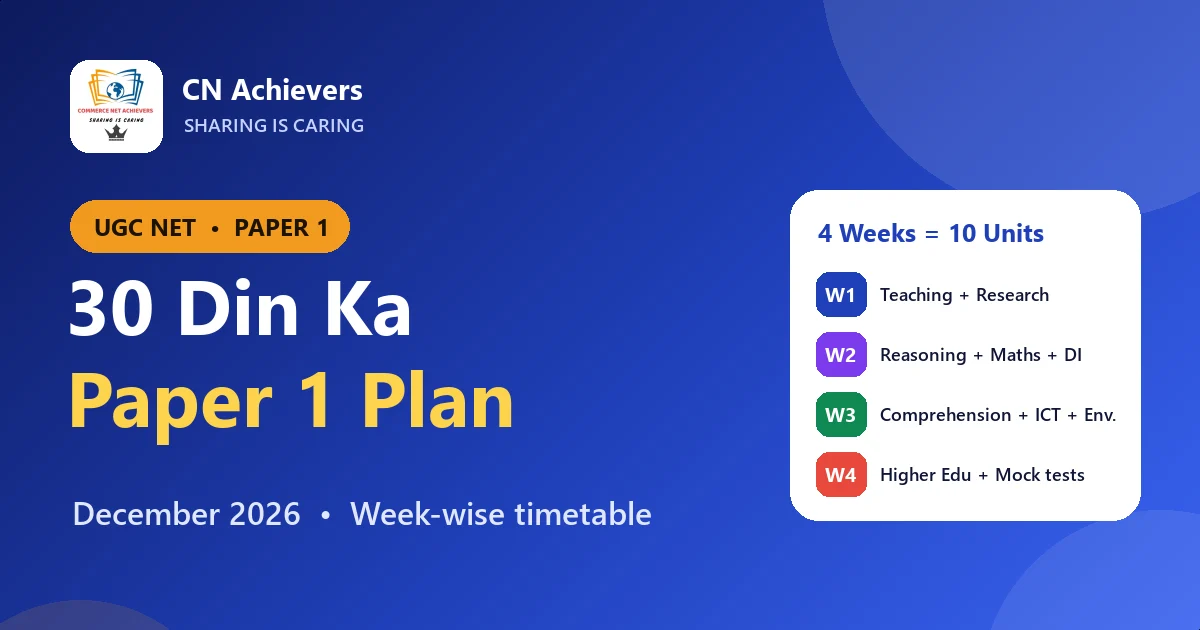
Ab syllabus clear hai to agla step hai plan. Hamara 30 din ka Paper 1 plan zaroor padhiye — usme week-wise timetable diya hai.
7.0 PRO - PAPER 1 - UGC NET DECEMBER 2026 (copy)
Aakhri baat
Paper 1 ka syllabus bada lagta hai, par har unit chhota aur clear hai. Unit-wise padhiye, har unit ke baad PYQ kijiye, aur har hafte ek mock test dijiye — Paper 1 mein achhe marks pakke hain.
Kisi unit mein doubt ho to neeche comment kijiye. All the best! 💪
Note: Syllabus UGC ke official UGC-NET Paper 1 syllabus par aadharit hai. Kisi bhi badlaav ke liye NTA / UGC ki official website dekhiye.
 Paper 1
💬 Comments
No comments yet — be the first to ask or share your thoughts.