
UGC NET Commerce (subject code 08) ka Paper 2 aapke total score ka sabse bada hissa hai — 300 mein se 200 marks isi paper ke hote hain. Syllabus 10 units mein bata hua hai aur pehli nazar mein kaafi bada lagta hai: Accounting se lekar Law aur Income-tax tak sab kuch. Par jab aap ise unit-wise todkar dekhte hain, to har unit ka scope clear ho jaata hai.
Is guide mein aapko milega:
- Commerce Paper 2 ka exam pattern
- 10 units ka official syllabus, unit-wise topics ke saath
- Har unit ko kaise padhna hai
- Syllabus se judi aam galtiyan
Commerce Paper 2: exam pattern ek nazar mein
- 100 sawal, har sawal 2 marks ka — kul 200 marks
- Paper 1 (50 sawal) aur Paper 2 dono milakar 3 ghante — beech mein break nahi
- Negative marking nahi — koi sawal khaali mat chhodiye
- 10 units hain, to average lagbhag 10 sawal per unit maan kar chaliye (asal mein kisi unit se thode kam-zyada aate hain)
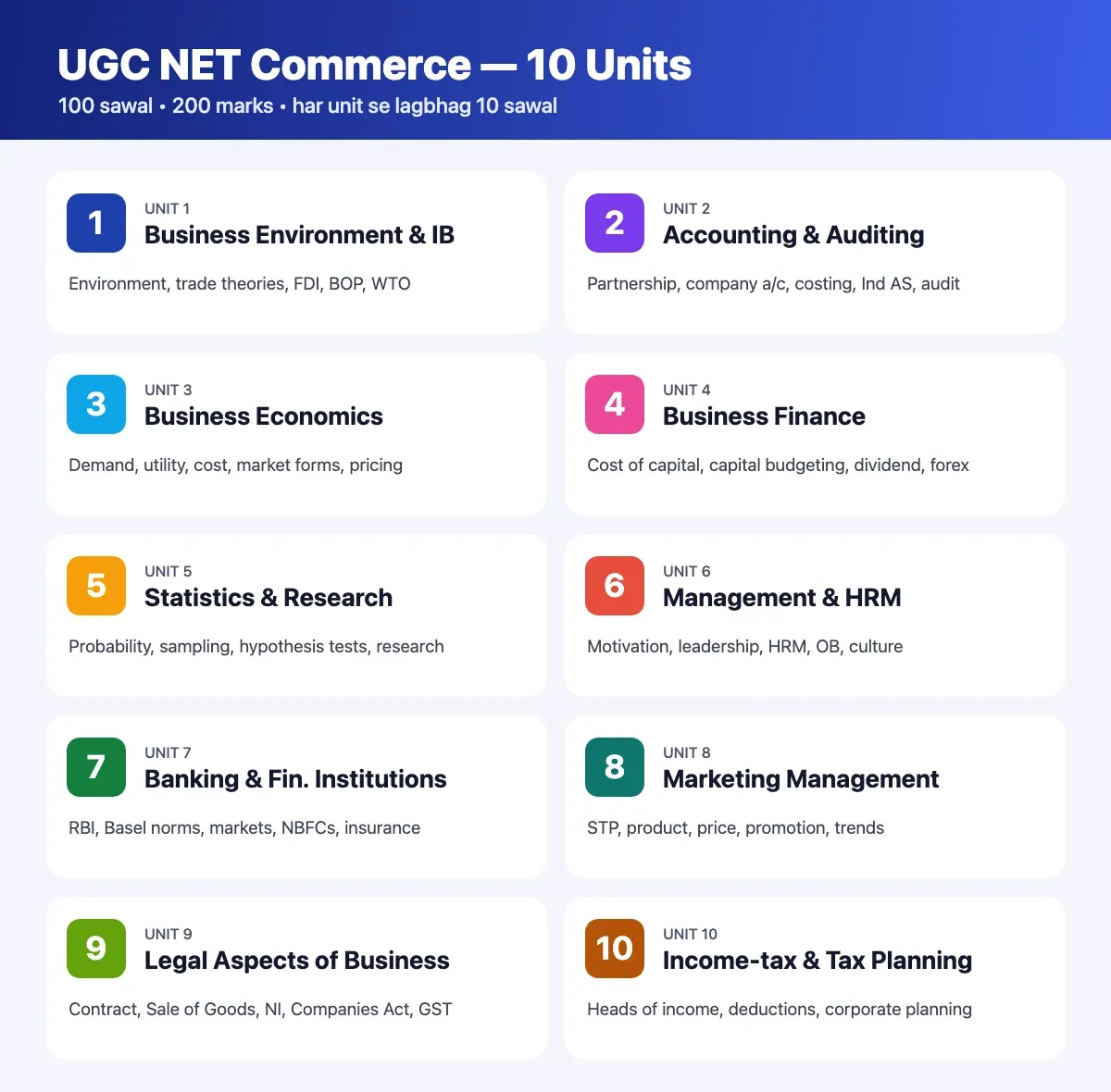
UGC NET Commerce ke 10 units
- Business Environment and International Business
- Accounting and Auditing
- Business Economics
- Business Finance
- Business Statistics and Research Methods
- Business Management and Human Resource Management
- Banking and Financial Institutions
- Marketing Management
- Legal Aspects of Business
- Income-tax and Corporate Tax Planning
Ab har unit ko detail mein dekhte hain.
Unit 1: Business Environment and International Business
- Business environment: economic environment (economic systems, monetary aur fiscal policy), political environment (business mein government ka role), legal environment (Consumer Protection Act, FEMA), socio-cultural factors aur CSR
- International business: scope aur importance, globalization aur uske drivers, international business mein entry ke modes
- International trade: theories of trade, trade mein government intervention, tariff aur non-tariff barriers, India ki foreign trade policy
- FDI aur FPI: FDI ke types, home aur host country ke liye costs aur benefits, FDI trends, India ki FDI policy
- Balance of Payments (BOP): importance aur components
- Regional economic integration: levels, trade creation aur diversion effects; EU, ASEAN, SAARC, NAFTA
- International institutions: IMF, World Bank, UNCTAD
- WTO: functions aur objectives; Agriculture Agreement, GATS, TRIPS, TRIMS
Kaise padhein: yeh facts aur concepts ka unit hai. WTO agreements, trade blocs aur FDI policy ke liye ek chhota "facts sheet" banaiye aur current affairs se update karte rahiye.
Unit 2: Accounting and Auditing
- Basic accounting principles, concepts aur postulates
- Partnership accounts: admission, retirement, death, dissolution aur insolvency
- Corporate accounting: shares ka issue, forfeiture aur reissue; liquidation; acquisition, merger, amalgamation aur reconstruction
- Holding company accounts
- Cost aur management accounting: marginal costing aur break-even analysis, standard costing, budgetary control, process costing, Activity Based Costing (ABC), decision-making ke liye costing, life cycle costing, target costing, Kaizen costing aur JIT
- Financial statement analysis: ratio analysis, funds flow aur cash flow analysis
- Human Resources Accounting, Inflation Accounting, Environmental Accounting
- Indian Accounting Standards aur IFRS
- Auditing: independent financial audit, vouching, assets aur liabilities ka verification aur valuation, financial statements ka audit aur audit report, cost audit
- Auditing ke recent trends: management, energy, environment, systems aur safety audit
Unit 3: Business Economics
- Business economics ka meaning aur scope; business firms ke objectives
- Demand analysis: law of demand, elasticity of demand aur uska measurement, AR aur MR ka relationship
- Consumer behaviour: utility analysis, indifference curve analysis
- Law of Variable Proportions aur Law of Returns to Scale
- Theory of cost: short-run aur long-run cost curves
- Market forms mein price determination: perfect competition, monopolistic competition, oligopoly (price leadership model), monopoly, price discrimination
- Pricing strategies: price skimming, price penetration, peak load pricing
Accounting, Finance, Statistics aur Income-tax — in chaar units mein numerical aur concept dono tarah ke sawal aate hain. Inhe sirf padhkar nahi, roz thode sawal solve karke taiyar kijiye.
Unit 4: Business Finance
- Finance ka scope aur sources; lease financing
- Cost of capital aur time value of money
- Capital structure
- Capital budgeting: conventional aur scientific techniques
- Working capital management; dividend decision — theories aur policies
- Risk aur return analysis; asset securitization
- International monetary system
- Foreign exchange market; exchange rate risk aur hedging techniques
- International financial markets aur instruments: Euro currency, GDRs, ADRs
- International arbitrage; multinational capital budgeting
Unit 5: Business Statistics and Research Methods
- Measures of central tendency, dispersion aur skewness
- Do variables ka correlation aur regression
- Probability: approaches to probability, Bayes' theorem
- Probability distributions: binomial, Poisson aur normal
- Research: concept aur types; research designs
- Data: collection aur classification
- Sampling aur estimation: probability aur non-probability sampling, sampling distribution, central limit theorem, standard error, statistical estimation
- Hypothesis testing: z-test, t-test, ANOVA, Chi-square test, Mann-Whitney (U-test), Kruskal-Wallis (H-test), rank correlation test
- Report writing
Hypothesis testing ka ek table banaiye: kaun sa test kab lagta hai (parametric ya non-parametric), kitne groups ke liye, aur kaun sa data chahiye. Is unit ke kaafi sawal isi "kab kaun sa test" wali samajh se solve ho jaate hain.
Unit 6: Business Management and Human Resource Management
- Management ke principles aur functions
- Organization structure: formal aur informal organization, span of control
- Responsibility aur authority: delegation aur decentralization
- Motivation aur leadership: concept aur theories
- Corporate governance aur business ethics
- HRM: concept, role aur functions; HR planning; recruitment aur selection; training aur development; succession planning
- Compensation management: job evaluation, incentives aur fringe benefits
- Performance appraisal, 360 degree appraisal samet
- Collective bargaining aur workers' participation in management
- Organizational behaviour: personality, perception, attitudes, emotions, group dynamics, power aur politics, conflict aur negotiation, stress management
- Organizational culture: organizational development aur change
Kaise padhein: motivation aur leadership theories ke naam, unke thinkers aur main idea ki ek list banaiye — matching type sawalon mein yahi kaam aati hai.
Unit 7: Banking and Financial Institutions
- Indian financial system ka overview
- Banks ke types: commercial banks, RRBs, foreign banks, cooperative banks
- RBI: functions, role aur monetary policy management
- Banking sector reforms: Basel norms, risk management, NPA management
- Financial markets: money market, capital market, government securities market
- Financial institutions: DFIs, NBFCs, mutual funds, pension funds
- India ke financial regulators
- Financial sector reforms, financial inclusion samet
- Digital banking: internet banking, mobile banking, digital payment systems
- Insurance: life aur non-life insurance, risk classification aur management, insurability ki limits, re-insurance, IRDA aur uska role
Unit 8: Marketing Management
- Marketing: concept aur approaches, marketing channels, marketing mix, strategic marketing planning, segmentation, targeting aur positioning
- Product decisions: product line, product mix, product life cycle, new product development
- Pricing decisions: price ko affect karne wale factors, pricing policies aur strategies
- Promotion decisions: advertising, personal selling, publicity, sales promotion, promotion mix
- Distribution decisions: channels of distribution aur channel management
- Consumer behaviour: buying process aur buying decisions ko affect karne wale factors
- Service marketing
- Marketing ke trends: social, online, green, direct aur rural marketing; CRM
- Logistics management
Unit 9: Legal Aspects of Business
- Indian Contract Act, 1872: valid contract ke elements, capacity of parties, free consent, discharge, breach aur remedies, quasi contracts
- Special contracts: indemnity aur guarantee, bailment aur pledge, agency
- Sale of Goods Act, 1930: sale aur agreement to sell, Caveat Emptor, unpaid seller aur buyer ke rights
- Negotiable Instruments Act, 1881: types, negotiation aur assignment, dishonour aur discharge
- Companies Act, 2013: companies ke nature aur kinds, formation, management, meetings aur winding up
- LLP: structure aur formation ka procedure
- Competition Act, 2002, IT Act, 2000 (cyber crimes aur penalties samet), RTI Act, 2005 — objectives aur main provisions
- IPR: patents, trademarks, copyrights aur emerging issues
- GST: objectives, main provisions, benefits, implementation aur dual GST ka working
Income-tax ke liye zaroori update: naya Income-tax Act, 2025 ab purane 1961 wale Act ki jagah le chuka hai. Official syllabus ke topics wahi hain, par concepts aur sections naye Act ke hisaab se padhiye, aur NTA ki taraf se syllabus par koi bhi notice aaye to use zaroor check kijiye.
Unit 10: Income-tax and Corporate Tax Planning
- Income-tax: basic concepts, residential status aur tax incidence, exempted incomes, agricultural income, alag-alag heads ke under taxable income ka computation, gross total income se deductions, individuals ka assessment, clubbing of incomes
- International taxation: double taxation aur use avoid karne ka mechanism, transfer pricing
- Corporate tax planning: concept aur significance, tax avoidance vs tax evasion, tax planning ki techniques; specific situations mein tax considerations — make or buy, own or lease, retain/renew/replace asset, shut down ya continue
- TDS aur TCS, advance tax, income-tax return ki e-filing
Kaun sa unit kaise padhein?
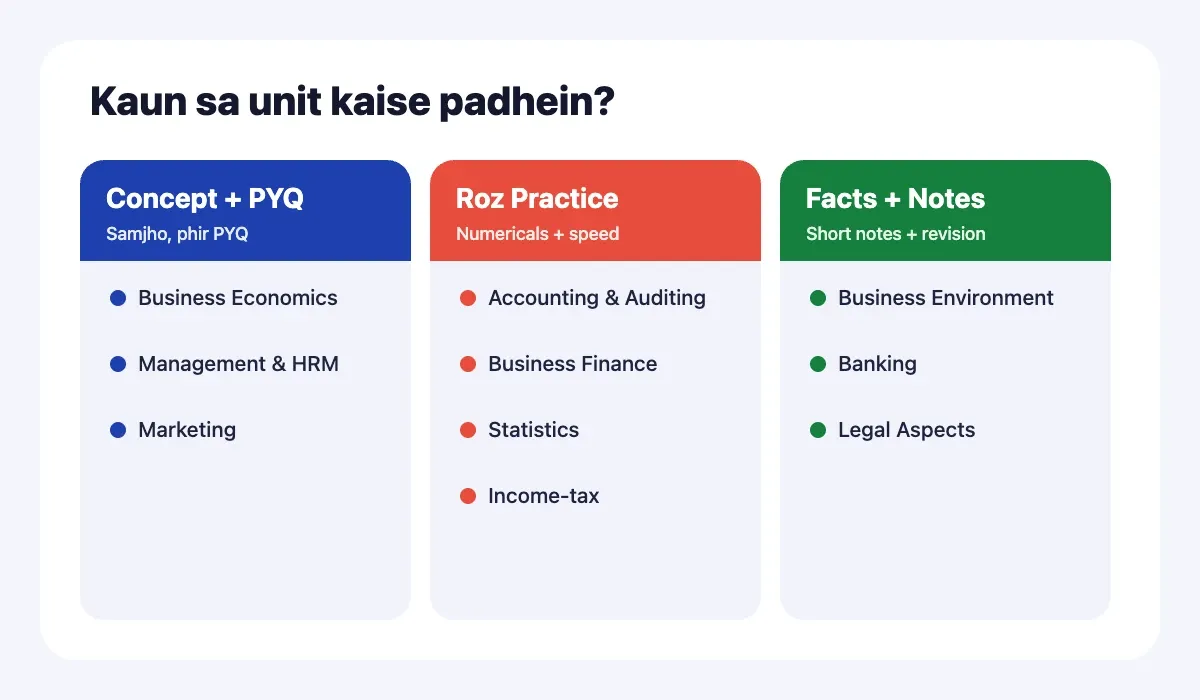
Saare units ek jaise nahi hote. Inhe teen hisson mein baant kar padhiye:
- Practice wale units — Accounting (Unit 2), Finance (Unit 4), Statistics (Unit 5), Income-tax (Unit 10): concept samjhiye, phir roz numericals aur PYQ.
- Samajh wale units — Business Economics (Unit 3), Management & HRM (Unit 6), Marketing (Unit 8): theories aur unke thinkers yaad rakhiye, examples se samjhiye.
- Facts aur provisions wale units — Business Environment (Unit 1), Banking (Unit 7), Law (Unit 9): short notes banaiye aur baar-baar revise kijiye; current updates bhi jodte rahiye.
Syllabus se judi aam galtiyan
- Law aur Tax ko last ke liye chhodna — yeh units lambe hain aur last mein ratne se yaad nahi rehte.
- Bahut saari books — har unit ke liye ek achha source chuniye aur usi ko 2–3 baar revise kijiye.
- Sirf theory padhna — Accounting, Finance aur Statistics bina practice ke exam mein time khaate hain.
- Paper 1 ko ignore karna — Commerce ke saath Paper 1 ke 100 marks bhi utne hi zaroori hain. Iske liye hamara Paper 1 syllabus guide padhiye.
- Mock test na dena — 3 ghante mein 150 sawal ki speed sirf mocks se banti hai.
Exam ki dates, fees aur naye badlaav ke liye hamara UGC NET December 2026 notification wala post bhi dekh lijiye.

7.0 PRO - COMMERCE - UGC NET DECEMBER 2026
Aakhri baat
Commerce ka syllabus bada hai, par har unit ka scope fixed hai. Unit-wise padhiye, har unit ke baad uske PYQ kijiye, numericals roz practice kijiye, aur har hafte ek full mock dijiye — Paper 2 mein achha score pakka hai.
Kisi unit mein doubt ho to neeche comment kijiye. All the best! 💪
Note: Yeh syllabus UGC ke official UGC-NET Commerce (Code 08) syllabus par aadharit hai. Kisi bhi badlaav ke liye NTA / UGC ki official website dekhiye.
 Exam Updates
  Paper 1
  Paper 1
💬 Comments
No comments yet — be the first to ask or share your thoughts.